Tallahassee, FL · Garage Door Service
Havana homes built around 1978 run original cable drums and worn tracks. We travel from Tallahassee to fix frayed or snapped cables on these older setups.
Crawfordville's housing stock skews newer than a lot of what we see closer to Tallahassee. The median build year out here is around 2004, which puts most garage doors on steel torsion systems with factory-installed openers rather than the older extension-spring setups you find on houses from the 1980s and earlier. That's a different repair profile. You're less likely to be dealing with a rusted-out extension spring pulley and more likely to be dealing with a circuit board issue, a worn drive gear on a belt-drive opener, or a photo-eye sensor knocked out of alignment. The door panels themselves also tend to be newer insulated steel rather than the thin single-layer panels common on older stock. That said, newer doesn't mean maintenance-free - torsion springs on a 2004-era door are now old enough to be near end of life, since a properly sized spring is usually rated for a set number of cycles, not a set number of years. If your door was installed around when the house was built, you're in the window where a spring failure becomes a real possibility, not a remote one.
Across the wider service area, home construction runs from 1978 to 2004, with a lot of that stock concentrated in the 1980s and 90s. Crawfordville sits at the newer end of that range. With roughly 2,305 households in the immediate area and a median household income above $74,000, this isn't a place where we see the oldest, most worn-out door hardware in the region - that's more common in the older, denser neighborhoods closer to town. What we do see is opener boards and safety sensors reaching the age where they start acting up, plus tracks that have shifted slightly out of alignment from normal settling. A mild climate with occasional freeze events doesn't stress steel doors the way harsher winters do, but it does mean weatherstripping and bottom seals wear from UV and humidity rather than ice, and that's worth checking even on a door that otherwise looks fine.
Crawfordville is about 19 miles from our shop in Tallahassee, so when you call for a repair here, factor in drive time when you're thinking about scheduling - we're not sitting around the corner. We don't keep a depot or staff stationed in Crawfordville; every job here is a truck coming out from Tallahassee. That's not a knock against the town, it's just the honest layout of how we cover this part of the service area. If you need a same-day fix on a spring or opener, say so when you call, and we'll work out timing around the drive rather than promise something we can't back up from 19 miles away.
Given the build years, the calls we get from Crawfordville lean toward opener repair and replacement more than spring work, at least compared to older parts of the service area. Circuit board failures, worn drive belts on belt-drive systems, and misaligned photo-eye sensors are common on doors from the early 2000s that have been running for two decades. Torsion springs installed at construction are also starting to hit the age where failure becomes likely, so we do get spring calls too - just not as the dominant job type the way they are on 1980s-era doors. One honest limitation: if a spring or opener part is discontinued or unusual for the door's age, we may need to order it rather than pull it off the truck, and that can add a day or two. We won't guess at a part number over the phone to avoid that delay.
No. We're based in Tallahassee, about 19 miles away, and we drive out to Crawfordville for jobs. We don't keep a local depot or staff stationed here, so factor drive time into your scheduling when you call.
An opener from that era is well past the point where boards, belts, and sensors commonly start failing. It's not automatically due for replacement, but if you're seeing intermittent issues, the age lines up with normal end-of-life wear rather than a fluke.
Often yes. Newer construction here tends to have torsion spring systems and factory openers rather than the older extension-spring setups common on 1980s houses, so the failure points and replacement parts differ.
Call now or request a free quote - same-day service on most repairs, upfront written pricing.
The fault we see most in Havana isn't a dead opener or a stuck panel - it's a cable that's frayed down to a few strands, or one that's already let go and dropped the door crooked on one side. That's a cable job, not a spring job, and the two get confused a lot because both leave a door that won't move right.
Havana's housing stock runs older than a lot of the areas we cover out of Tallahassee - median build year here sits around 1978. A door installed with a house from that era has been through roughly four and a half decades of cable wear, and most of those original cables were never swapped out unless something broke. Galvanized aircraft cable does corrode from the inside where you can't see it, especially where it wraps the drum. By year forty, the strands nearest the drum groove are usually the weakest point on the whole door, and that's exactly where they tend to go.
We drive the 16 miles out from Tallahassee for these calls regularly enough to know the pattern: it's rarely a fresh installation failing. It's the original hardware finally giving up.
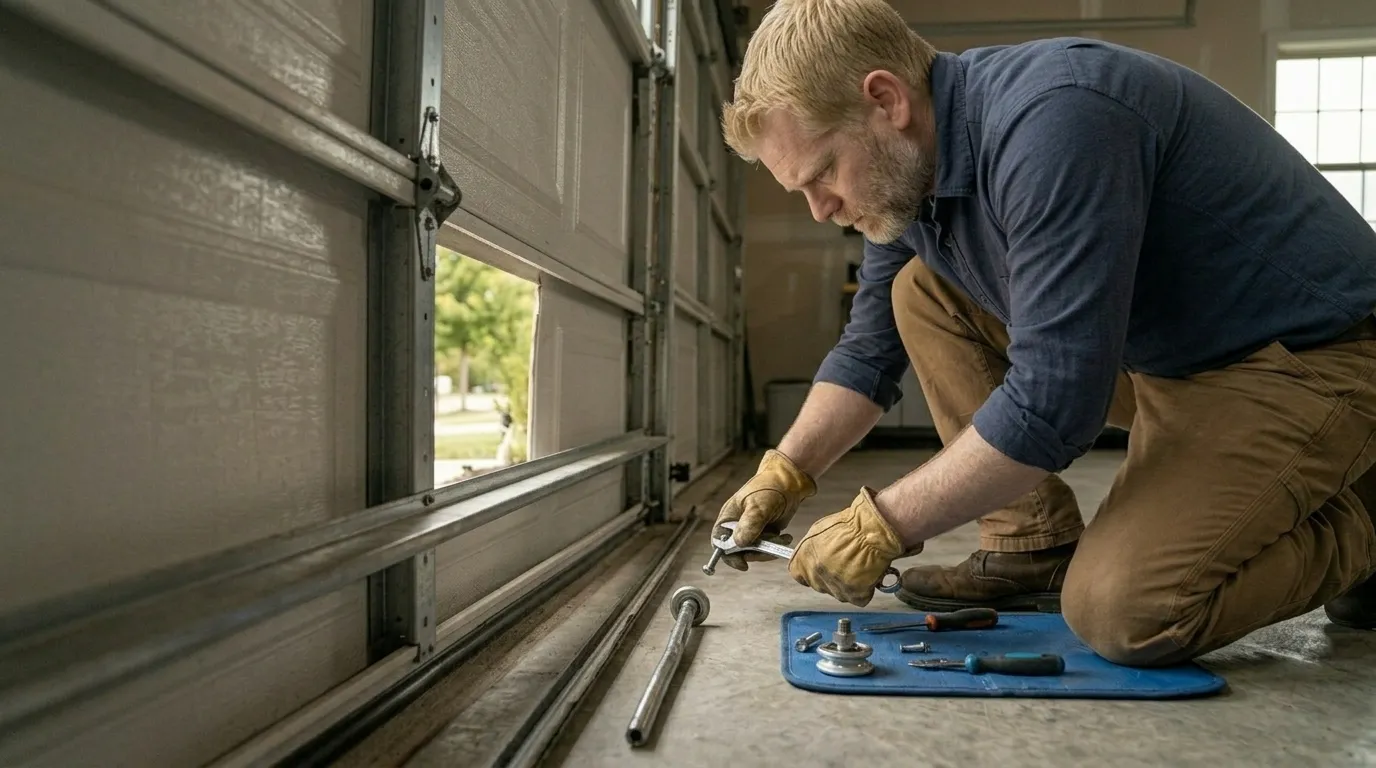
A cable repair on a door this age is straightforward in theory - pull the old cable off the drum, wind on new cable to the right length, reset tension, check the drum itself for wear. The complication with 1978-era doors is that the drums and end bearing plates have often never been replaced either, and forty-plus years of use groove them unevenly. A new cable on a worn drum will still ride rough and re-fray faster than it should.
We check the drum and the bearing plate every time we're doing a cable, not just the cable itself. If the drum's grooved out, swapping the cable alone is a short-term fix that has you calling again inside a year or two. That's the honest tradeoff: sometimes the cheaper repair costs more over three years than doing the drum and cable together once.
We don't stock every obsolete drum size on the truck - some of the older torsion setups used hardware that isn't common stock anymore, and if that's what we find, the part has to be sourced before the job finishes. We'll tell you that on site rather than promise a same-visit fix we can't back up.
It usually starts small. The door goes up unevenly, one side lagging the other by an inch or two, then straightens out - that's a cable starting to slip on the drum before it's fully failed. Left alone, it goes from uneven to jammed, and eventually the door drops on one side entirely, sometimes with the opener still trying to pull it and grinding against the track.
A fully snapped cable on a double-wide door is the call we get most from this stretch of the county - the door comes down crooked and stays wedged in the track, and it's not something to force by hand. With Havana's mild winters and occasional freeze nights, cold snaps aren't the main driver of wear here the way they are further north, but a freeze can make an already-weak cable brittle enough to go on the next cold morning instead of a mild one.
If your door is groaning, hesitating, or hanging a little off-level before it moves, that's worth a call before it fails outright and locks the car in or out.
This isn't a fault that shows up the same way everywhere in the service area. Housing stock across the wider Tallahassee coverage zone spans 1978 to 2004, but Havana sits at the early edge of that range, which means a higher share of original, never-replaced cable hardware than in the newer subdivisions closer to town. Median household income here runs $54,153, a bit under the $57,600 average across the households we serve, and that tends to track with owners holding onto original garage hardware longer rather than replacing it preemptively.
Havana isn't a large service pocket - around 1,017 households - so we're not out here daily the way we might be in a denser suburb. That means when a cable does go, it's often gone further than it would if it had been caught early, because there's less routine foot traffic past the garage from other jobs nearby to catch it. It's not a reason to worry, just a reason not to let a slightly uneven door sit for a season.
Cables usually fray for months before they let go, but the fraying happens inside the wind on the drum where you can't see it. On a house built around the late 1970s, like a lot of Havana homes, that cable may be original - four decades of flex is enough for the strands nearest the drum to give out suddenly even though the visible cable looked fine.
If one cable has snapped, the door is unevenly supported and can drop further or come off the track if forced. Don't run the opener and don't try to lift it manually past a few inches. Leave it as is and call - trying to squeeze a car under a door hanging on one cable is how a bent track happens on top of the original problem.
For common sizes, yes. Some torsion hardware from the late 1970s used drum and bearing plate sizes that aren't standard stock anymore, and if we find that on your door, we'll tell you on site rather than promise a fix we can't finish that visit. We'd rather be straight about a return trip than force a part that doesn't fit right.