Tallahassee, FL · Garage Door Service
Havana homes built in 1978 still run mostly on original track and rollers. Here's why that hardware comes off the rail first, and what the fix actually takes.
Crawfordville's housing stock skews newer than a lot of what we see closer to Tallahassee. The median build year out here is around 2004, which puts most garage doors on steel torsion systems with factory-installed openers rather than the older extension-spring setups you find on houses from the 1980s and earlier. That's a different repair profile. You're less likely to be dealing with a rusted-out extension spring pulley and more likely to be dealing with a circuit board issue, a worn drive gear on a belt-drive opener, or a photo-eye sensor knocked out of alignment. The door panels themselves also tend to be newer insulated steel rather than the thin single-layer panels common on older stock. That said, newer doesn't mean maintenance-free - torsion springs on a 2004-era door are now old enough to be near end of life, since a properly sized spring is usually rated for a set number of cycles, not a set number of years. If your door was installed around when the house was built, you're in the window where a spring failure becomes a real possibility, not a remote one.
Across the wider service area, home construction runs from 1978 to 2004, with a lot of that stock concentrated in the 1980s and 90s. Crawfordville sits at the newer end of that range. With roughly 2,305 households in the immediate area and a median household income above $74,000, this isn't a place where we see the oldest, most worn-out door hardware in the region - that's more common in the older, denser neighborhoods closer to town. What we do see is opener boards and safety sensors reaching the age where they start acting up, plus tracks that have shifted slightly out of alignment from normal settling. A mild climate with occasional freeze events doesn't stress steel doors the way harsher winters do, but it does mean weatherstripping and bottom seals wear from UV and humidity rather than ice, and that's worth checking even on a door that otherwise looks fine.
Crawfordville is about 19 miles from our shop in Tallahassee, so when you call for a repair here, factor in drive time when you're thinking about scheduling - we're not sitting around the corner. We don't keep a depot or staff stationed in Crawfordville; every job here is a truck coming out from Tallahassee. That's not a knock against the town, it's just the honest layout of how we cover this part of the service area. If you need a same-day fix on a spring or opener, say so when you call, and we'll work out timing around the drive rather than promise something we can't back up from 19 miles away.
Given the build years, the calls we get from Crawfordville lean toward opener repair and replacement more than spring work, at least compared to older parts of the service area. Circuit board failures, worn drive belts on belt-drive systems, and misaligned photo-eye sensors are common on doors from the early 2000s that have been running for two decades. Torsion springs installed at construction are also starting to hit the age where failure becomes likely, so we do get spring calls too - just not as the dominant job type the way they are on 1980s-era doors. One honest limitation: if a spring or opener part is discontinued or unusual for the door's age, we may need to order it rather than pull it off the truck, and that can add a day or two. We won't guess at a part number over the phone to avoid that delay.
No. We're based in Tallahassee, about 19 miles away, and we drive out to Crawfordville for jobs. We don't keep a local depot or staff stationed here, so factor drive time into your scheduling when you call.
An opener from that era is well past the point where boards, belts, and sensors commonly start failing. It's not automatically due for replacement, but if you're seeing intermittent issues, the age lines up with normal end-of-life wear rather than a fluke.
Often yes. Newer construction here tends to have torsion spring systems and factory openers rather than the older extension-spring setups common on 1980s houses, so the failure points and replacement parts differ.
Call now or request a free quote - same-day service on most repairs, upfront written pricing.
Havana sits about 16 miles from our shop in Tallahassee, and that drive is part of the math on every off-track call out here. We don't keep a branch in Havana, so when a door comes off the rail, the truck is coming from town - we factor that into scheduling rather than pretending otherwise. What we can tell you is what we'll find when we get there: this is one of the older pockets in our whole service area. The typical Havana house went up around 1978, well ahead of the 1995 median build year across the wider region we cover. That gap matters more than it sounds like on paper. A door track installed in 1978 has usually seen forty-plus years of Florida humidity, lawn mower dings, and cars clipping the bottom bracket - and on a lot of these houses, nobody's touched it since.
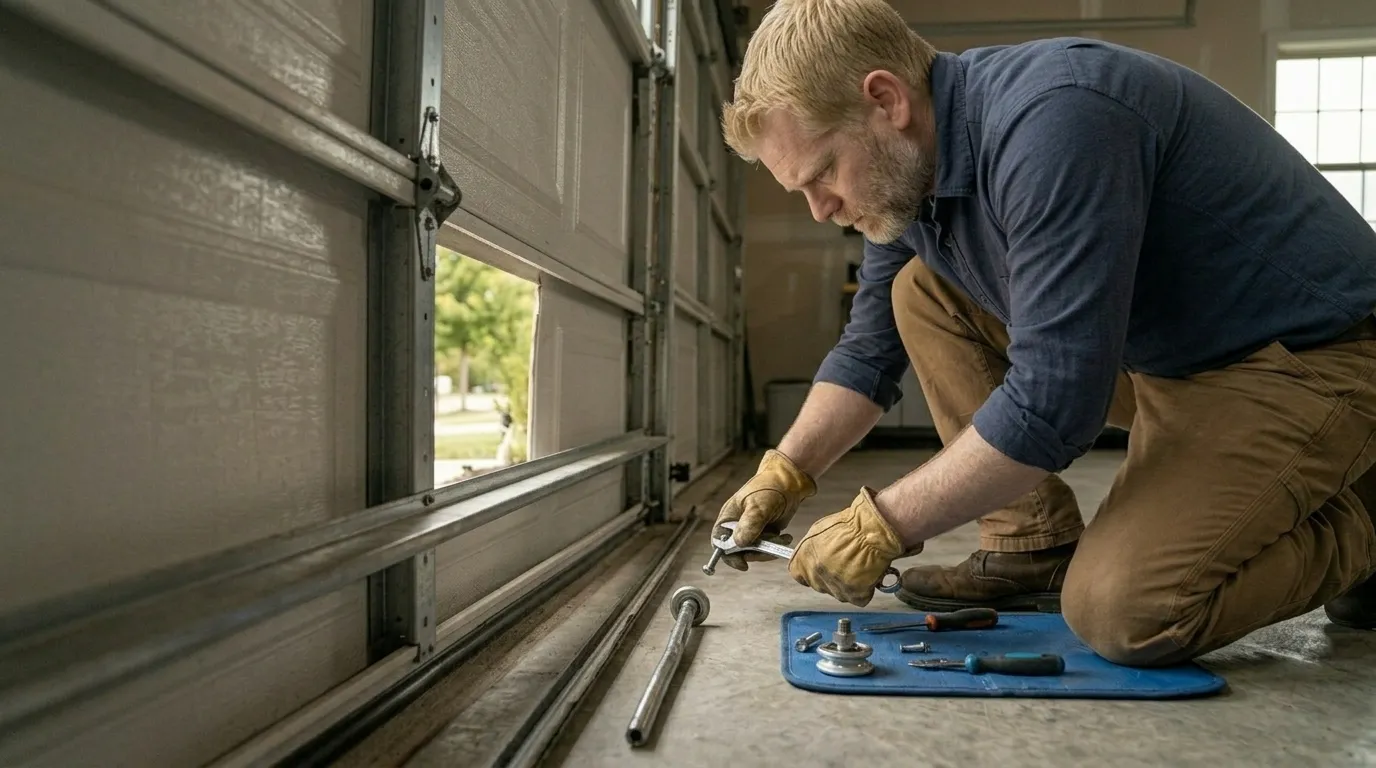
On a house this age, the first question isn't "why did it come off the track" - it's "which part of the original hardware finally gave out." Steel track sections from a late-1970s build are narrower-gauge than what gets installed today, and the mounting brackets were often nailed rather than lag-bolted into the jamb. When one bracket works loose, the whole track section can pull away from the frame, and the rollers ride right off the edge. Fixing it right usually means re-anchoring the track to solid framing, not just bending the rail back and rehanging it - bending it back is the shortcut that fails again inside a year. If the rollers themselves are original nylon or steel, we're often replacing those too, since forty-year-old rollers are usually the reason the door was already binding before it jumped the track. We don't recommend patching a track that's cracked at the bend; at that point you're paying twice.
In Havana, the pattern is pretty consistent: the door runs fine most of the way up, then hitches or jerks near the top of the second panel, right where the original bracket sits. Some owners hear a clunk and then the door won't move at all - that's a roller that's already left the track and jammed against the bracket. Others notice it gradually: the door starts riding crooked, dragging on one side, or leaving a gap along the bottom weatherstrip that wasn't there last year. On single-car openings especially, we see the low bracket pull away first, since it takes the brunt of every bump from a car bumper or a ladder leaned against the frame over four decades.
Two things stack up in Havana that don't stack the same way everywhere in our coverage area. First, the age of the stock - a median build year of 1978 means the hardware on a lot of these doors predates the newer track and bracket standards used on houses built through the 1990s and 2000s. Second, the climate band here runs mild with occasional freeze, which doesn't sound severe, but it means the wood framing around these older openings goes through decades of swelling and slight shrinking with humidity swings rather than one hard freeze-thaw cycle. That slow movement is what walks the original nail-set brackets loose over time - it's not a single storm, it's forty years of small shifts. With household incomes in this area running below the wider region's median, we also see more owners choosing a track and bracket repair over a full door replacement when the panel itself is still sound, and for a lot of these 1978 doors, that's a reasonable call.
Yes. A lot of Havana homes were built around 1978, and unless a door's been replaced outright, the track and mounting brackets are often original. We see this more here than in newer parts of our coverage area, where houses run closer to a 1995 median build year.
Sometimes, if the bend is minor and the bracket is still solid. But on hardware this old, a track that's already flexed once is more likely to fail again. If the bracket anchoring is loose or the rail is cracked at the bend, rebending it is a short-term fix we'd tell you not to pay for twice.
No. We're based in Tallahassee, about 16 miles out, and we travel to Havana for jobs. There's no local branch, so scheduling factors in that drive rather than a same-town response.
No. If the panel and opener are sound and it's the track or rollers that failed, we repair that hardware rather than push a full door. Replacement makes more sense when the track damage is tied to a bent or cracked panel, not before.