Tallahassee, FL · Garage Door Service
Woodville homes date mostly to the late 1980s, meaning original steel rollers on stamped tracks. Here's what roller replacement actually involves for this housing stock.
Crawfordville's housing stock skews newer than a lot of what we see closer to Tallahassee. The median build year out here is around 2004, which puts most garage doors on steel torsion systems with factory-installed openers rather than the older extension-spring setups you find on houses from the 1980s and earlier. That's a different repair profile. You're less likely to be dealing with a rusted-out extension spring pulley and more likely to be dealing with a circuit board issue, a worn drive gear on a belt-drive opener, or a photo-eye sensor knocked out of alignment. The door panels themselves also tend to be newer insulated steel rather than the thin single-layer panels common on older stock. That said, newer doesn't mean maintenance-free - torsion springs on a 2004-era door are now old enough to be near end of life, since a properly sized spring is usually rated for a set number of cycles, not a set number of years. If your door was installed around when the house was built, you're in the window where a spring failure becomes a real possibility, not a remote one.
Across the wider service area, home construction runs from 1978 to 2004, with a lot of that stock concentrated in the 1980s and 90s. Crawfordville sits at the newer end of that range. With roughly 2,305 households in the immediate area and a median household income above $74,000, this isn't a place where we see the oldest, most worn-out door hardware in the region - that's more common in the older, denser neighborhoods closer to town. What we do see is opener boards and safety sensors reaching the age where they start acting up, plus tracks that have shifted slightly out of alignment from normal settling. A mild climate with occasional freeze events doesn't stress steel doors the way harsher winters do, but it does mean weatherstripping and bottom seals wear from UV and humidity rather than ice, and that's worth checking even on a door that otherwise looks fine.
Crawfordville is about 19 miles from our shop in Tallahassee, so when you call for a repair here, factor in drive time when you're thinking about scheduling - we're not sitting around the corner. We don't keep a depot or staff stationed in Crawfordville; every job here is a truck coming out from Tallahassee. That's not a knock against the town, it's just the honest layout of how we cover this part of the service area. If you need a same-day fix on a spring or opener, say so when you call, and we'll work out timing around the drive rather than promise something we can't back up from 19 miles away.
Given the build years, the calls we get from Crawfordville lean toward opener repair and replacement more than spring work, at least compared to older parts of the service area. Circuit board failures, worn drive belts on belt-drive systems, and misaligned photo-eye sensors are common on doors from the early 2000s that have been running for two decades. Torsion springs installed at construction are also starting to hit the age where failure becomes likely, so we do get spring calls too - just not as the dominant job type the way they are on 1980s-era doors. One honest limitation: if a spring or opener part is discontinued or unusual for the door's age, we may need to order it rather than pull it off the truck, and that can add a day or two. We won't guess at a part number over the phone to avoid that delay.
No. We're based in Tallahassee, about 19 miles away, and we drive out to Crawfordville for jobs. We don't keep a local depot or staff stationed here, so factor drive time into your scheduling when you call.
An opener from that era is well past the point where boards, belts, and sensors commonly start failing. It's not automatically due for replacement, but if you're seeing intermittent issues, the age lines up with normal end-of-life wear rather than a fluke.
Often yes. Newer construction here tends to have torsion spring systems and factory openers rather than the older extension-spring setups common on 1980s houses, so the failure points and replacement parts differ.
Call now or request a free quote - same-day service on most repairs, upfront written pricing.
Most doors we open up in Woodville are steel sectional units from around the late 1980s, single doors on a lot of the smaller lots and double 16x7s where the driveway allows it. These came stock with light-gauge steel rollers riding in stamped-steel track, not the sealed-bearing nylon rollers you'd find in a door built in the last ten years. When one of those original steel rollers finally wears down, the stem bends before the wheel does, and that's usually the tell before the door starts binding.
We carry 7-ball and 10-ball nylon rollers with sealed bearings as the standard swap, since they run quieter and don't need the periodic oiling steel rollers demand. For doors where the track itself has worn a groove from decades of steel-on-steel contact, we also carry replacement track sections, because a new roller in a grooved track just wears the same way again within a year. We stock the common stem lengths and won't try to force a wrong-size roller into an old carrier.
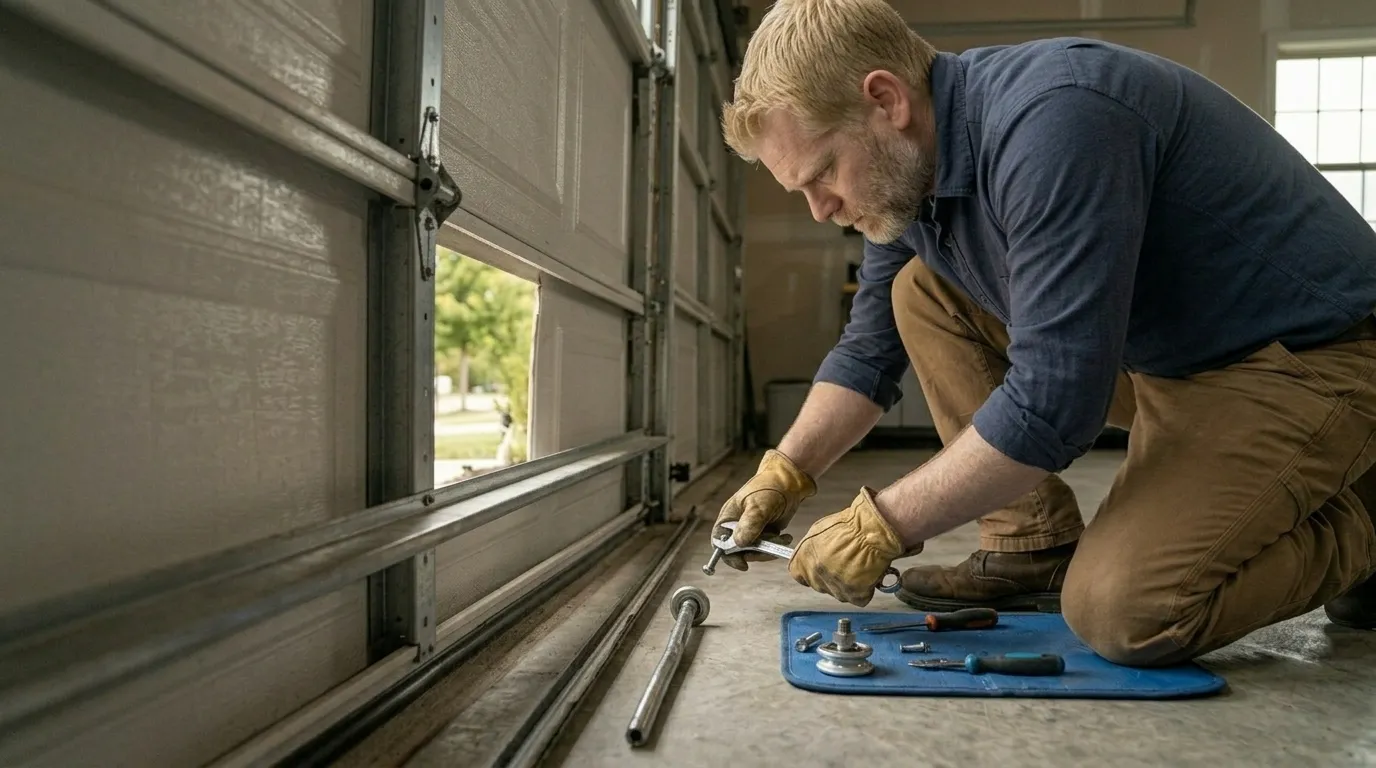
Swapping a single bottom roller on a door that isn't under spring tension is within reach for most people with the right pliers and a little patience. The rollers above the bottom fixtures are a different story: pulling them means working near a loaded torsion spring or extension cables, and on a door built in 1987 that spring has had close to four decades to develop fatigue nobody can see from the outside.
We'll say plainly what we don't do here: we don't talk anyone through a spring-adjacent roller job over the phone, and we won't sell just the part if the job clearly needs a second set of hands to hold the door section steady. If the roller failure is limited to the bottom two rollers and the door still tracks straight, a careful owner can often manage it. Past that, the risk of a cable jumping the drum outweighs the savings.
On a door this age the track has usually loosened slightly from the jamb over the years, so a worn roller doesn't fail cleanly, it fails while also fighting a track that's a half-inch out of plumb. That combination is what turns a five-minute roller swap into an hour of realigning brackets first. We see this pattern often enough in this part of the county that we check track alignment before we ever touch a roller, because replacing the part without fixing the track just buys another year.
The other failure mode is a roller stem that's rusted into the hinge rather than worn at the wheel. Even with mild winters here, decades of humidity work into that steel-on-steel joint, and forcing it out wrong can crack the hinge plate. On a 1987 door those hinge plates are original too, and a cracked one means an extra part on the truck, not just a roller.
We don't have a set price to quote here without seeing the door, since the range depends on how many rollers have failed, whether the track needs straightening, and whether any hinges came out damaged in the process. A single bottom roller swap is a small job. A full set of ten rollers plus track work on a door that's been neglected is a different job entirely, and we won't guess at that number sight unseen.
What we can say is that on a door from this era, replacing all the rollers at once usually costs less overall than replacing them two or three at a time as each one fails, since you're only paying for one visit instead of three. If you're already seeing two or more rollers grinding, it's worth doing the whole set.
Woodville's housing stock clusters tightly around the late 1980s, and that decade of garage doors shipped with steel rollers built to last maybe fifteen to twenty years under normal use, not the thirty-plus these doors have now put in. That's the core reason roller failure shows up so often here specifically, rather than being a generic wear issue: the timeline lines up with the building boom the area saw in that period.
The area's income profile also shapes how these jobs get handled. With median household income here running lower than the wider service area's, we see more owners choosing targeted roller replacement over a full door swap, which is a reasonable call when the panels and hardware are otherwise sound. It's also a smaller town by household count, which means fewer of these doors have already been replaced simply from turnover or renovation, so more of the original 1987-era rollers are still out there quietly wearing down.
Because we run this job out of Tallahassee, about 10 miles up the road, we plan the truck load before we leave rather than guessing on site. That means bringing both nylon and steel roller options, spare hinge plates, and track-straightening tools, since a door of this age rarely presents with just the one problem you called about.
On site, the job itself is straightforward once the door is secured: release tension safely, pull the worn rollers one at a time so the door never loses its track guides completely, check hinge condition as each one comes free, and reset alignment before the last roller goes back in. For a straightforward bottom-roller job this runs under an hour. Add track correction or hinge replacement and it runs longer, which is why we look the door over before quoting a time on site rather than over the phone.
Most homes in Woodville were built in the mid-to-late 1980s, and the steel rollers that shipped standard on doors from that period were rated for roughly fifteen to twenty years of daily use. Decades later, a large share of those original doors are hitting roller failure around the same time, simply because they went in around the same time.
Yes, if only one or two rollers show wear and the track is still straight. But on a door from this era, if two are worn the rest are usually close behind, and doing them all in one visit is typically cheaper than three separate call-outs as each one fails.
No. We're based in Tallahassee, about 10 miles away, and we load the truck for the specific job before heading out. There's no local depot, so we plan parts ahead rather than making a return trip for something we didn't bring.
Often, yes, if the noise is coming from worn roller wheels grinding in the track. But on a 1987-era door, noise can also come from a loosened track or a dried-out hinge, so we check those before assuming rollers alone will quiet it down.